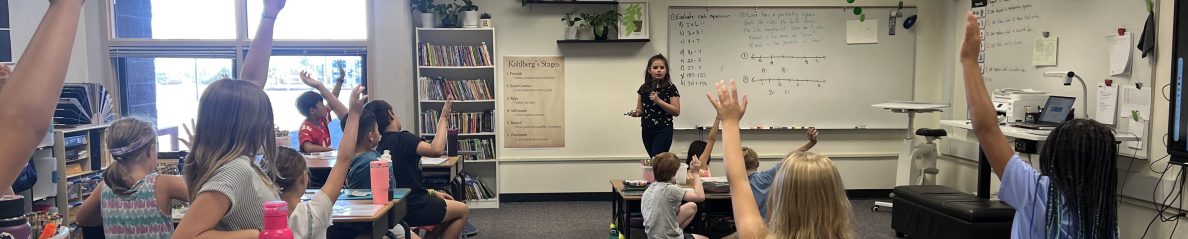
We are establishing our peer editing process in which we sit in a circle, pass our Writing Journals to each other, and identify strengths in what we are reading from colleagues. This is a strategy first introduced to me by Kitty Gillette, a 4th grade teacher at Westergard Elementary, and it has proven to be a great way of building classroom community. Moreover, it helps everyone become better writers.
Keep It or Junk It–A Discussion Strategy
Today the students used the strategy “Keep It or Junk It” to help us get ready for Kids Court and our Mock Trial. The Keep It or Junk It strategy has students working in small groups to identify key vocabulary from a text. This is followed by students working as a class to negotiate what the key vocabulary is and why. Words that are important are kept while words that are not, are junked.
The list of words will be used for writing an argumentative essay.

Yes, We Write in Math
Using Philosophical Chairs to Debate in Room360
Students got to engage in Philosophical Chairs today. They had to position themselves on a “Philosophical Spectrum” to express if they agreed, disagreed or were neutral on the topic of whether having classroom pets was more positive than negative. Students then took the hot seat to share their claims and the evidence, from middle school texts, they had collected to support their claims. Throughout the experience, students were encouraged to move as their opinion changed based on what their peers were sharing.
The students proved quite adept at the technique and we will be doing this again while we are studying American history.
Learning about the Structure of Matter
Today we started learning about the properties and behavior of different substances. Our first experiment is allowing us to get closer to understanding to fundamental ideas of chemistry including being able to describe mixtures and solutions. Over the coming weeks we will learn about density, mass, solubility, and chemical reactions.

Our Exploration of the Maya
We are one week into our exploration of the Maya and ancient civilizations in Mesoamerica. Our big question is how geography effects culture and we are sifting through some challenging material, collecting ideas and information, to answer this question. The use of the parenthetical will become key as we start supporting claims with evidence and appropriate reasoning. (And look, no uniforms, picture day!)
Room360’s First Structured Academic Controversy
Today we completed our first Structured Academic Controversy (SAC). Students read two articles about lunch policies in which some districts are requiring all children to eat meals prepared by the schools. Some students had to support the claim that children should be able to bring their own lunches while others had to argue the opposite.
This was an opportunity for students to learn to how to appropriately argue and consider perspective taking. In this case, students did not initially know which side they would take and had to prepare for both stances.
Word Study and a Game of Eye Spy
We are quickly establishing our Word Study routine and students know how to complete a closed sort, an open sort and how to integrate their understanding into a game of Eye Spy. We will briefly discuss Word Study at our Brown Bag Lunch in September. Until then, please consider playing a game of Eye Spy, using the words from school, over the next few weeks.
Learning through Inquiry with Saving Sam
In a scenario titled Saving Sam, students worked individually and with partners to develop strategies and solutions to a problem. In this case, Sam (the candy worm) was drowning and his only chance of survival involved placing a life preserver (Life Saver) over his body with nothing but two paper clips. Working individually, two students developed answers. Working with partners, 16 students were able to save Sam. Apart from learning through inquiry, there was likely another lesson buried in there.
Thank you Jolene Hamilton, 5th grade teacher at Verdi Elementary, for first sharing this lesson with me.
Learning to Annotate Text
Students are learning to annotate text and identify claims, evidence and reasoning. Despite this being our first attempt, the children have proven quite adept at the process and were able to find all the relevant information in the passage.
This is a strategy we will continue refine and apply throughout the year. This will prove especially important as we start Document Based Questions and We The People.