Thank you parents for sharing such a great celebration with the kids!


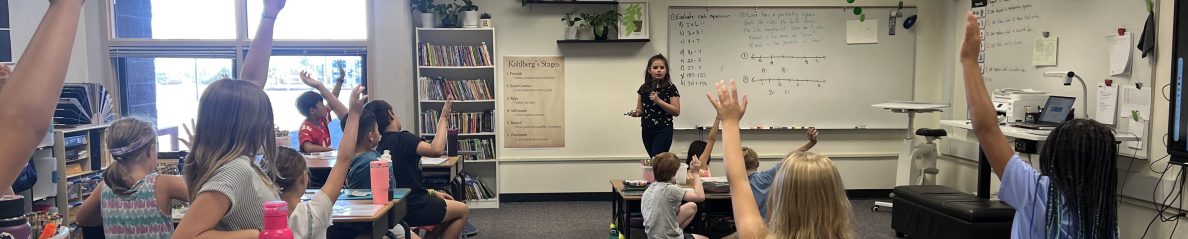
Thank you parents for sharing such a great celebration with the kids!
Today Gomm parents volunteered their time to facilitate art learning and creation for all of the students in 5th grade. The session started with some history about artist M.C. Escher followed by a chance for children to create their own tessellation pieces–based on Escher’s work.


Thank you to all the families who visited us for lunch today. Apart from sharing a meal, we also explored blended learning through adaptive technology, 21st Century communication, and “gamification.”


Today we continued to work with the ideas of concentration, dilution and volume. To help with this, we created an experiment in which students manipulated solutions to determine the effects on volume and mass. Ultimately, this experiment not only built greater understanding with the Next Generation Science Standards but also proved a terrific introduction to volume.


Today we got another visit from art teacher Joy Brackney. Mrs. Brackney shared with the students how to mix mediums with a Halloween themed piece of art.


Today we set-up our Google Classroom. Our first project involved using Google Docs to help us with taking our draft pieces of writing through the writing process and into publishing. Google Classroom also helped us with greater classroom flexibility and differentiation.
Students all have secure usernames and passwords and can continue working on their writing at any time. (This includes at home!) Moreover, I will always have access to what they are doing and I will be able to provide feedback.


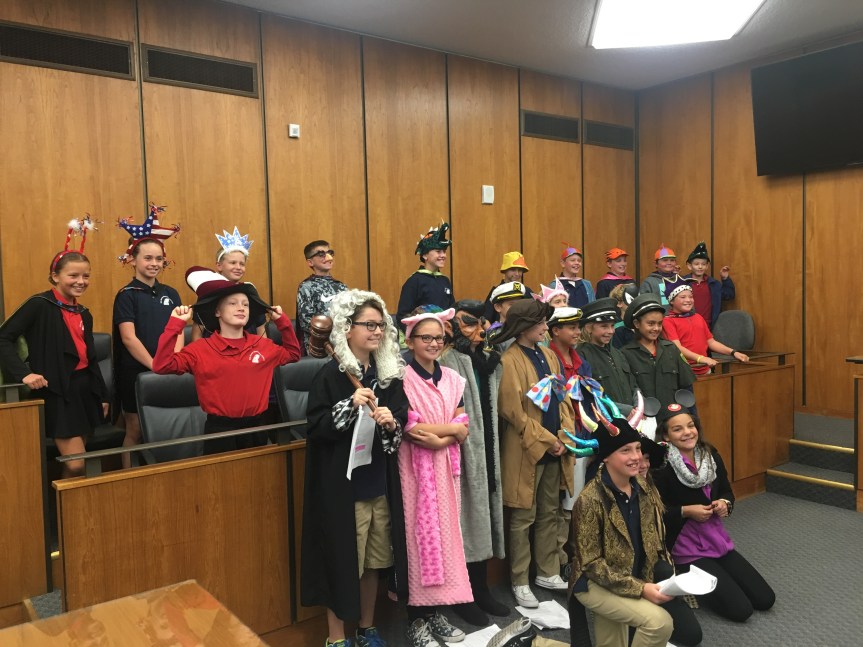
Today we visited the 2nd Judicial District Court to put on a mock trial. This was followed by learning more about the work of a court, information about jails and prisons, and a chance to “meet an inmate.”
The day included a lot of learning and a lot of fun. This was best exemplified by the cased we tried and adjudicated. Ultimately, the students found Curly Pig liable for damages in the case brought by B.B. Wolf.


Today we shared some of our writing during Author’s Chair. Over the last six weeks, we have been putting an emphasis on clearly establishing a situation/topic/problem with a strong introduction, well-sequenced events, and a satisfying conclusion.
The Author’s Chair is an opportunity to share writing and receive positive feedback from classmates.


Today students started their investigation into saturation. In this case, students added salt to water until the solution became saturated. Students then used a balance to determine the amount of salt that went into the solution.
This investigation is just beginning and we will learn about citric acid and how to compare crystals in the coming days.


We are establishing our peer editing process in which we sit in a circle, pass our Writing Journals to each other, and identify strengths in what we are reading from colleagues. This is a strategy first introduced to me by Kitty Gillette, a 4th grade teacher at Westergard Elementary, and it has proven to be a great way of building classroom community. Moreover, it helps everyone become better writers.


