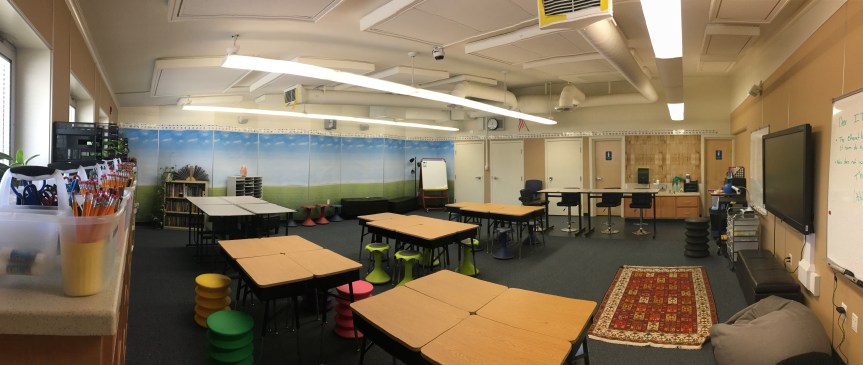
I cleaned out my classroom and moved everything into my new 3rd grade room.
I’ve loved my two years in 5th and I am looking forward to new challenges and opportunities in the coming academic year.
We finished the year with a burst. We completed our study of Shakespeare’s A Midsummer Nights Dream, a full unit on sound, multiple opportunities to identify claims, evidence and reasoning in informational text and the elements of plot in narrative (exposition, rising action, climax, and falling action.) We “stepped-up” to sixth grade with mini investigations of negative integers, area of parallelograms and right triangles, and finding rate. We also moved through several inquiry activities including Youcubed.org in which we learned about conjectures. In other words, we ended the year the way we started it, by working hard.
I am not entirely sure how far back the Great American Day tradition goes but it was fun to continue what Mrs. Dunn, who retired last year, firmly established. Students picked a Great American and spent the last eight weeks researching the person. This was turned into a full report and then synthesized into a one-minute speech the students shared with the Roy Gomm community.
We’ve been rehearsing lines and we discussed iambic pentameter. Today was a chance to move through Act 1, Scene 1 of Shakespeare’s A Midsummer Night’s Dream.
Despite all of the challenges, the kids persisted with the tasks and were able to identify the exposition, rising action and conflict in what we read.

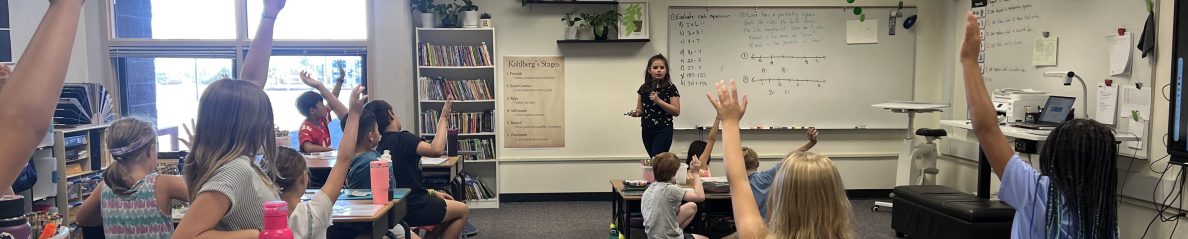
We were visited by Dr. Amy Salgo who introduced the students to Stronger and Clearer Each Time. The instructional approach was developed by the Understanding Language Project at Stanford University and has students engage in multiple rehearsals of a problem or question before coming to a final answer.
Dr. Salgo asked the students if fractions are numbers and the students ultimately arrived at the conclusion, yes!

We used a sample Smarter Balanced Test item to get ready for a persuasive essay on service animals. We read through three texts, annotated for evidence and then rehearsed for our writing using a Fishbowl.
In a Fishbowl, students sit in a circle with several students in the middle. Participants share ideas around a topic and if someone in the middle needs help or has run out of ideas, they will replace themselves with someone from the outside.